Universal Access
Posted: August 22, 2012 | Author: Steven Harris | Filed under: Professional development | Leave a comment »Brewster Kahle, founder of the Internet Archive, will present the webinar “Universal Access to All Knowledge” on September 5, 2012. The presentation is sponsored by the Association for Library Collections & Technical Services (ALCTS).
Together with his wife, Mary Austin, Mr. Kahle started The Kahle/Austin Foundation, which supports the Internet Archive along with other non-profit organizations with similar goals. Additionally, Mr. Kahle is the founder of Open Content Alliance, a group of organizations contributing to a permanent, publicly accessible archive of digitized texts.
Registration information:
http://www.ala.org/alcts/confevents/upcoming/webinar/09052012
Wednesday, September 5, 2012
This session will be 90-minutes long, starting:
11am Pacific | 12 Mountain | 1pm Central | 2pm Eastern
ALCTS Continuing Education
Posted: July 12, 2012 | Author: Steven Harris | Filed under: Professional development | Leave a comment »Upcoming ALCTS Continuing Education Events
http://www.ala.org/alcts/confevents
- Turning Statistics into Assessment
- Role of the Profession in Academic Research Technical Services Departments
- Federal Depository System (in conjunction with GODORT)
- Library as Place: Making the Library an Inviting Environment
If you have additional e‑forums ideas, please contact Kristin Martin.
- The Future of the Integrated Library? (August 1)
- Universal Access to All Knowledge (September 5)
- Demand Driven Acquisitions: Part 1 and 2 (September 19 and October 3)
- Digital Preservation: Part 1 and 2 (October 10 and November 14)
- Principles of Classification (October 24)
- Holdings Comparisons: Why are They So Complicated (November 28)
- Fundamentals of Acquisitions (September 17 ‑ October 12)
- Fundamentals of Collection Assessment (August 13 ‑ September 21)
- Fundamentals of Collection Development/Management (August 20 ‑ September 14)
- Fundamentals of Electronic Resources Acquisitions (September 24 ‑ October 19)
- Fundamentals of Preservation (September 10 ‑ October 5)
Posted on behalf of the ALCTS Continuing Education Committee.
Ebooks in K12
Posted: June 5, 2012 | Author: Steven Harris | Filed under: Collection Philosophy, E-books, Professional development | Leave a comment »Here is an interesting workshop for those in K-12 being offered by ALA Techsource:
“Choosing an E-Book Platform that Works for Your K12 Library”
being lead by Buffy J. Hamilton
August 8
http://www.alastore.ala.org/detail.aspx?ID=3832&zbrandid=4634
Emerging Research
Posted: May 30, 2012 | Author: Steven Harris | Filed under: Professional development | Leave a comment »Don’t miss the ALCTS Collection Management Section forum at ALA
“Emerging Research in Collection Management & Development”
http://connect.ala.org/node/137991
Collaborative Collection Conference
Posted: May 25, 2012 | Author: Steven Harris | Filed under: Collection Philosophy, Professional development | Leave a comment »Collaborative collection development has been on our lips for 30 years. It’s one of those topics that, to paraphrase Mark Twain (or whoever), everybody talks about but nobody does anything. I exaggerate. There have been a lot of what I’ll call prospective collection collaboration: shared subscriptions, buying clubs, cooperative approval plans. But retrospective collaboration is a tough nut. “Retrospective collaboration?” you say. What to do about managing existing collections, especially monograph collections, in a collaborative fashion? How to weed our monograph collections in an extensive fashion (creating spaces for other activities), while still preserving the greatest diversity of the scholarly and cultural record? Now THAT is on my lips all the time these days.
And its on the lips of several great presenters for ALCTS. See this ALCTS virtual preconference to learn a lot more about this kind of collaboration:
Local Collections, Collective Context: Managing Print Collections in the Age of Collaboration
June 4-6: there are three sessions, 90 minutes each, beginning at: 11am Pacific, noon Mountain, 1pm Central, 2pm Eastern
http://www.ala.org/alcts/events/ala/ac/12/collaborationage
Sign up now! I’ll see you there.
Why?
Posted: May 18, 2012 | Author: Steven Harris | Filed under: Collection Philosophy, Professional development | 2 Comments »I had tea yesterday with a long-time Medieval Studies/English Literature faculty member here. She has always been a heavy user of the library and a real supporter of everything we do. She’s actually retired but still doing a lot of things in the English Department on a part-time basis. Yesterday, she turned to me and asked earnestly, “why is the library going so electronic in everything it does?”
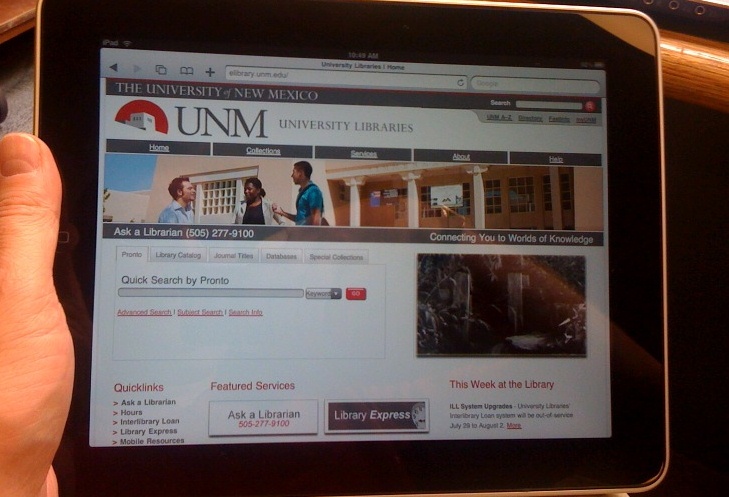
How would you answer that question?
Georgia State E-Reserves
Posted: May 15, 2012 | Author: Steven Harris | Filed under: Online collections, Professional development | Leave a comment »A verdict has finally been issued in the Georgia State University e-reserves case (Cambridge University Press et al v. Patton et al). Several publishers were suing GSU over their electronic reserves practices. The judge’s decision is mostly favorable to libraries. Most of the particular claims of infringement were rejected. The case, however, may establish some specific guidelines or safe havens that may not be exactly what librarians would want.
Further summaries of the case:
Tech Timeline
Posted: February 21, 2012 | Author: Steven Harris | Filed under: Online collections, Professional development | Leave a comment »I’ve been working on a tech timeline (both personal and library) that I thought more appropriate over on my personal blog. Tell me about the technological change you’ve experienced in your career.
Transforming Collections
Posted: February 17, 2012 | Author: Steven Harris | Filed under: Collection Philosophy, Professional development | Tags: ALCTS, training | Leave a comment »ALCTS E-Forum:
Date: February 22 & 23
Description: “Join us to talk about all the ways our collections are changing and discuss topics such as handling new formats, preservation methods, repository services, planning for the future, best practices for moving forward, and budgeting for changing times. Come share your success stories about how you are meeting the research, teaching, and recreational needs of your users of today and tomorrow.”
Occupy Elsevier
Posted: February 2, 2012 | Author: Steven Harris | Filed under: Collection Philosophy, Professional development | 1 Comment »There is an academic boycott of Elsevier going on now that is getting a lot of press and social media chatter. (See “The Cost of Knowledge.”) I know Rick Anderson has written a post about the boycott over at Scholarly Kitchen, but I am going to refrain from reading his thoughts until I get this post down. (Perhaps a follow-up after I read it.) In the interest of disclosure, I should say that I work in a library that is a big customer of Elsevier. In fact, we recently licensed the “Freedom Collection” of bundled journals from that publisher.
The point of the boycott is to encourage scientists and scholars to sign a pledge not to publish in, referee for, or do editorial work with any Elsevier journals. The rationale given on the web page is three-fold (my paraphrase): 1) their prices are high, 2) their practice of bundling journals saddles libraries with a lot of titles they don’t want, 3) they support SOPA, PIPA, and the Research Works Act.
I do not deny that each of these points is bad for libraries and for scholarly communication generally, nor that they apply to Elsevier. But I do want to raise a couple of points of concern about the boycott.
- The boycott seems a bit like déjà vu all over again. Our discourse regarding scholarly communication has been vilifying Elsevier specifically for at least 20 years. I often have conversations with faculty in which they say, “I know Elsevier is bad, but…” or “I thought we were supposed to avoid Elsevier…” And, yet, with that knowledge, faculty continue to publish in Elsevier journals and serve on Elsevier editorial boards. In short, all that negative publicity has done little to affect the bottom line of Elsevier, but more importantly, has not changed the high rating and impact of many Elsevier journals.
- All three of the issues raised by the boycott apply equally to dozens of other scholarly publishers. Why are they not included in the boycott? What can the boycott hope to achieve if other publishers simple take up what Elsevier loses? Are we to believe that an open access paradise will be achieved by taking on the large scholarly publishers one at a time? We will have a sequence of boycotts for Wiley, Springer, Sage, Taylor & Francis?
- I have always thought that libraries were always stuck between a rock and a hard place regarding high-priced scholarly journals. The solution has never been that libraries should simply cancel their subscriptions. The very process of promotion and tenure in higher education requires that faculty publish in the highest rated journals, regardless of the sales practices of those journals. I don’t think, however, that the boycott as it is currently organized presents a coordinated effort that will get the desired results.
I admit to be at a loss to how this boycott ought to be organized. The rot here goes to the very heart of the P&T system in higher eduction. Individual scientists can sign the boycott, but that will have little impact if, at the point of tenure review, entire academic departments (or even entire universities) do not discount the value high-price journals and take predatory publishing into account. It is difficult to see how that kind of journal evaluation can take hold without coordination that goes even beyond department and university, encompassing entire academic disciplines and all the journals serving those disciplines.